
 English
  Português
  Deutsch
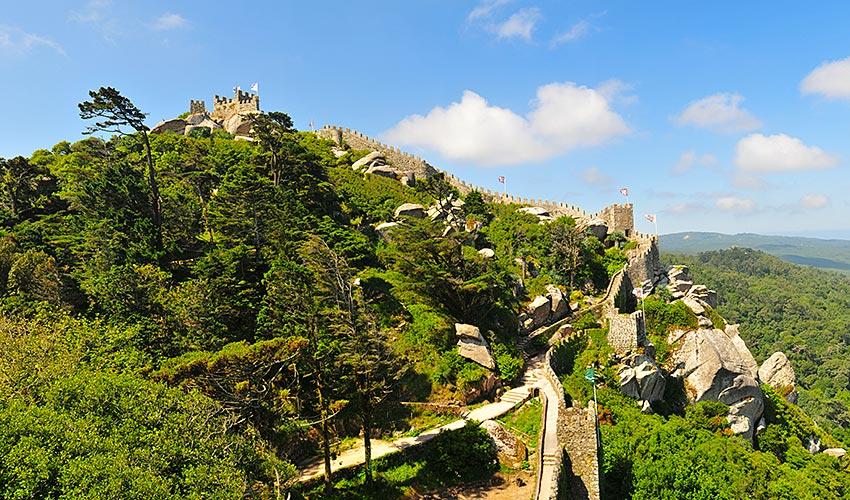
Early Portugal was shaped by the Romans for over 600 years, the Visigoths for the next two centuries and African Muslims (the Moors) for almost 800 years. Portugal was recognised as a separate kingdom in 1143 under the rule of King Afonso I and with the help of Christian military groups, the last remnants of Muslim power were defeated by 1249.
The Age of Discoveries
During the 15th and 16th centuries, Portuguese sailors embarked to explore the unknown world. Successful expeditions were made to Africa and the Americas, and Vasco da Gama’s passage to India opened up a sea route to the empires of the east. The Age of Discoveries was a time of tremendous wealth and the Portuguese Empire expanded worldwide, establishing colonies in Angola, Mozambique, Cape Verde, São Tomé and Príncipe, Guinea (presently Guinea-Bissau), Brazil, Goa, Macau and East Timor. With the success of these voyages, Portugal emerged as one of the richest countries in the world and a major European power in terms of economic, political and cultural influence.
Decline of the Empire
Over the next 300 years, Portugal was occupied by the Spanish, invaded by the French and endured trade rivalries with British and Dutch fleets. Internal struggles and disputes over sovereign succession caused Portugal to lose much of its wealth and status. In 1755, the catastrophic Lisbon earthquake destroyed much of the capital as well as areas of the Algarve. The cumulative turmoil caused by centuries of invasion and civil conflict ushered in an era of social discontent, political instability and economic decline.
Republic, Repression and Revolution
In 1910, the monarchy was overthrown by military forces and Portugal declared as a Republic. António de Oliveira Salazar was appointed Prime Minister in 1932 and soon devolved into a fascist dictator. Portugal was transformed under his rigidly authoritarian Estado Novo (New State), which controlled the media and elections, as well as the civil liberties of the population.
On 25 April 1974, the regime was overthrown by a peaceful, left-wing military coup, known as the Carnation Revolution. Portugal’s Liberation Day is commemorated with streets named “Rua 25 de Abril” in nearly every town.
Modern Portugal, a founding member of NATO and a member of the European Union, has evolved into a country with a stable democracy and vibrant cultural life.

