English
  Português
  Deutsch
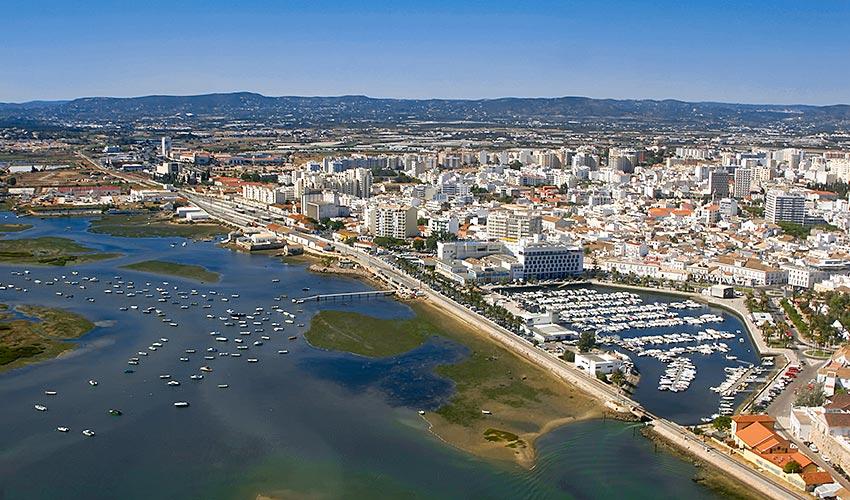
Faro is the regional capital of the Algarve. A favourite holiday destination, this bustling city lies alongside one of the most beautiful natural wonders of the region, the 60 km-long expanse of lagoons, natural dunes and stunning beaches of the Ria Formosa Nature Park. The beaches are many, ranging from the thriving resort of Ilha de Faro with its bars, restaurants and abundant amenities, to the seclusion of the miles of uninhabited sand dunes of Barreta island, lying between the ocean and one of the estuary’s lagoons.
The calm, warm waters of Faro’s gorgeous beaches attract swimmers and water sports enthusiasts alike. Jet skiers, windsurfers and pleasure craft often frequent the lagoons, and boat trips are available for scenic tours around the maze of canals that criss-cross the marshlands and sand bars of this beautiful area. The marshlands are a favourite nesting ground for migratory birds, so you might well spot flocks of flamingos and a variety of other species on the way. During the summer months, boats also provide access to the peaceful beach of Barreta island.
The city of Faro is a busy cosmopolitan centre, offering plenty of entertainment and numerous shops and restaurants. It also retains its traditional charm, as a walk around the old city centre will soon confirm. The narrow little streets house many shops selling local handicraft and it is hard to resist the local almond-based sweets, the Dom Rodrigos, at any one of the city’s pastry shops. Traditional fish restaurants provide the local shellfish specialities that often come straight from the estuary. International cuisine is readily available throughout the city and the Forum Algarve shopping centre contains a number of fast food outlets.
Golfers will be in their element with the numerous golf courses available in the surrounding area, namely the Pinheiros Altos, Quinta do Lago South, Quinta do Lago North, Laranjal, Royal and Ocean courses.
Faro has always been an important trading centre due to its strategic location at the mouth of the estuary. Its prominence during Roman and Moorish occupation was heightened during the 15th and 16th century Portuguese voyages of discovery and impressive monuments were erected as a result of its prosperity. Its fortunes were reversed in subsequent centuries as the city fell prey to the attack of an English army led by the Earl of Essex in 1536 and later felt the devastating effects of the 1755 earthquake. Faro boasts many beautiful monuments that attest to its former glory and that merit a visit.
Places to see
Religious monuments
Sé Catedral (Cathedral)
Situated in the historic Vila-Adentro area of the city, Faro Cathedral was built on the site of a 13th century church and a former Moorish mosque. Ravaged by the English attack of the 16th century and the 18th century earthquake, it was rebuilt at the end of the 18th century and is therefore a blend of architectural styles. The first floor tower and two of its chapels are all that remain of the original church. From its vantage point, you can enjoy the sight of the many storks’ nests adorning the roofs of surrounding buildings.
Igreja da Ordem Terceira de São Francisco (Church of the Third Order of St. Francis)
Originally built as part of the Convent of St. Francis in the 17th century, significant alterations were made in the 18th and 19th centuries. Beautiful tiles, paintings and the retable in the chancel are especially noteworthy features.
Ermida de Santo António do Alto (Chapel of Santo António do Alto)
Built next to a 14th century watchtower, this chapel is thought to date from the 15th century. It was altered after partial destruction during the 1755 earthquake and its beautiful retable was the work of the renowned 17th century Algarvian woodcarver, Manuel Martins. A museum dedicated to Saint Anthony lies alongside the chapel.
Igreja de São Pedro (St. Peter’s Church)
Situated near the waterfront, this medieval chapel was totally rebuilt in the 16th century when it was made the main parish church. Also partly destroyed by the 1755 earthquake, it has been subsequently modified but its chancel and chapels contain beautiful examples of Baroque and Rococo altarpieces and Baroque tiles.
Igreja da Ordem Terceira de Nossa Senhora do Monte do Carmo (Church of the Third Order of Our Lady of Mount Carmel)
The St. Joseph chapel in this 18th century church was the first example of the Rococo style in the Algarve. Especially noteworthy are the church’s ornate gilded retables, its painted panelled ceiling, the fine collection of Baroque statues and the notorious Chapel of Bones — lined with a somewhat macabre collection of artistically arranged skulls and bones from a displaced cemetery.
Museums
Museu Municipal de Faro (Faro Municipal Museum) housed in the Convento de Nossa Senhora da Assunção (our Lady of the Assumption Convent)
Located in Vila-Adentro, this 16th century convent is now home to the Faro Municipal Museum. Partially destroyed by the English in 1536, it continues to be one of the finest examples of early Renaissance architecture in the Algarve. The museum contains Roman and Medieval archaeological findings as well as numerous art collections.
Museu Marítimo Almirante Ramalho Ortigão (Admiral Ramalho Ortigão Maritime Museum)
Founded in 1931, this small museum is dedicated to all the sea-related activities that have so dominated the traditional way of life in the Algarve.
Museu Regional do Algarve (Algarve Regional Museum)
Founded in 1963, the museum contains an interesting collection of artefacts and instruments traditionally used in the Algarve.
Roman Ruins of Milreu These impressive Roman ruins near Estoi form part of a 3rd century villa, including the main residence, a temple and baths. Colourful mosaics depicting marine motifs emphasise Faro’s long association with the sea.