English
  Português
  Deutsch
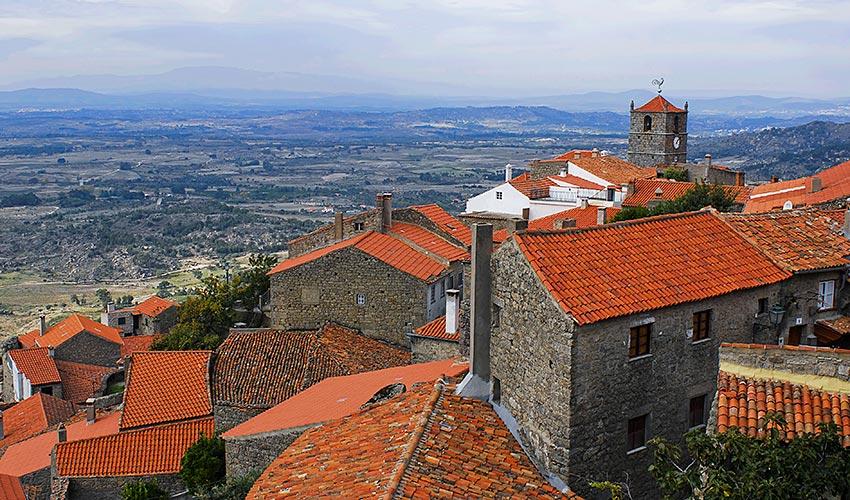
Discover the district of Guarda, a memorable destination where story-telling monuments guide you through Portugal’s earliest days.
Originally founded in the 12th Century by the second king of Portugal, D. Sancho I, the capital of Guarda lies in the mountainous landscape of Serra da Estrela and is regarded as the highest city in the country, standing at an impressive height of 1,056 metres (3,500 feet). Torre is the highest peak in the range (1,993 metres/6,500 feet), as well as the highest in mainland Portugal and is home to the famous ski resort of the Serra da Estrela Natural Park.
Nearby you can find the quaint mountaintop villages of Seia and Manteigas, splendid places to visit any time of the year, whether you prefer skiing on beautiful snow-covered hills or taking peaceful nature hikes by the Zêzere river.
Known for its vital role as a frontier during the Middle Ages, Guarda (meaning ‘guard’) still holds many of the colossal castles that once fortified the country. These can be visited in towns such as Figueira do Castelo, Pinhel and Almeida. Make sure you see the Castle of Sabugal and the Castle of Sortelha, excellent representations of the powerful military-inspired style that characterises these monumental structures.
Trancoso is one of Guarda’s most interesting towns for its countless religious landmarks, medieval Jewish quarter and traditional atmosphere. Travel further into time, beyond the Middle Ages and get a glimpse of the fascinating archaeological park of Foz Côa, a site containing one of the largest open-air collections of Palaeolithic engravings in the world.
Places to see
Historical and Cultural Sites
Guarda's Cathedral (Guarda)
This cathedral stands in the heart of Guarda and is regarded as the most significant attraction in the district. Although its construction was initiated towards the end of the 12th Century under the rule of D. João I, the cathedral was only completed in the 16th Century. As a result of the years it took to build the structure, the monument possesses a combination of Gothic and Manueline architecture. In the 19th Century, Portuguese architect Rosendo Carvalheira restored parts of the cathedral – some of the best revivalist work seen in the country today.
Guarda’s Museum (Guarda)
Put your travelling books aside and unveil Guarda’s earliest origins at this inviting museum. Organised into several sections according to theme, from geography and economy, to captivating examples of traditional dress, crafts and art, this museum will teach you everything there is to know about the historical heritage of this remarkable district.
Jewish Quarters (Guarda)
During the Middle Ages, Guarda was home to a hard-working Jewish community who contributed largely to the region’s economical and social development. In the 15th Century, Portuguese Jews became victims of the ruthless persecution stirred by the Inquisition and were forced to convert to Catholicism or flee the country. Walk around the silent, cobble-stoned streets of Guarda’s Jewish quarters and find typical low-rise houses, remains of medieval walls and narrow passageways that seem to lead you further into the past. In Trancoso, visit the Casa do Gato Negro, the ‘House of the Black Cat’, an old building believed to have been home to a rabbi or maybe, a synagogue.
Corgas da Matança Dolmen (Fornos de Algodres)
Also known as the Orca de Corgas da Matança, this dolmen (portal tomb) is an extraordinary relic that has provided its visitors with a deeper understanding of those who lived in the Iberian Peninsula during the Neolithic Period. Nine pillar-shaped stones (some with engravings) holding a large, horizontal stone, compose this impressive 4 metre-tall megalithic monument.
Excavated Medieval Graves (Fornos de Algodres)
The municipality of Fornos de Algodres is often sought-after by history-lovers for its excavated graves – an impressive trace left from the Middle Ages. A common characteristic these graves share is the fact that they have been found in groups of what seem to be necropoli. The town of Vila Ruiva e Forcadas is home to a popular site and a place to visit if you are a curious traveller.
Archaeological Park of Foz Côa (Vila Nova de Foz Côa)
The Archaeological Park of Foz Côa is an officially protected site known for being one of the largest and most important collections of Palaeolithic art in Europe. Ever since its first discovery in 1991, over 20 groups of rocks with delicately engraved depictions of man and nature have been found throughout the Côa Valley – an amazing representation of mankind’s earliest artistic abilities.
20 Frontier Castles Tour of Guarda (Guarda)
Experience a once-in-a-lifetime trip back to Guarda’s medieval days and enjoy this truly exciting tour. With over 20 frontier castles to see, as well as many historical villages and ruins, you will have the opportunity to explore Guarda in depth and visit some of the frontier castles in its neighbouring districts, Castelo Branco and Coimbra.